
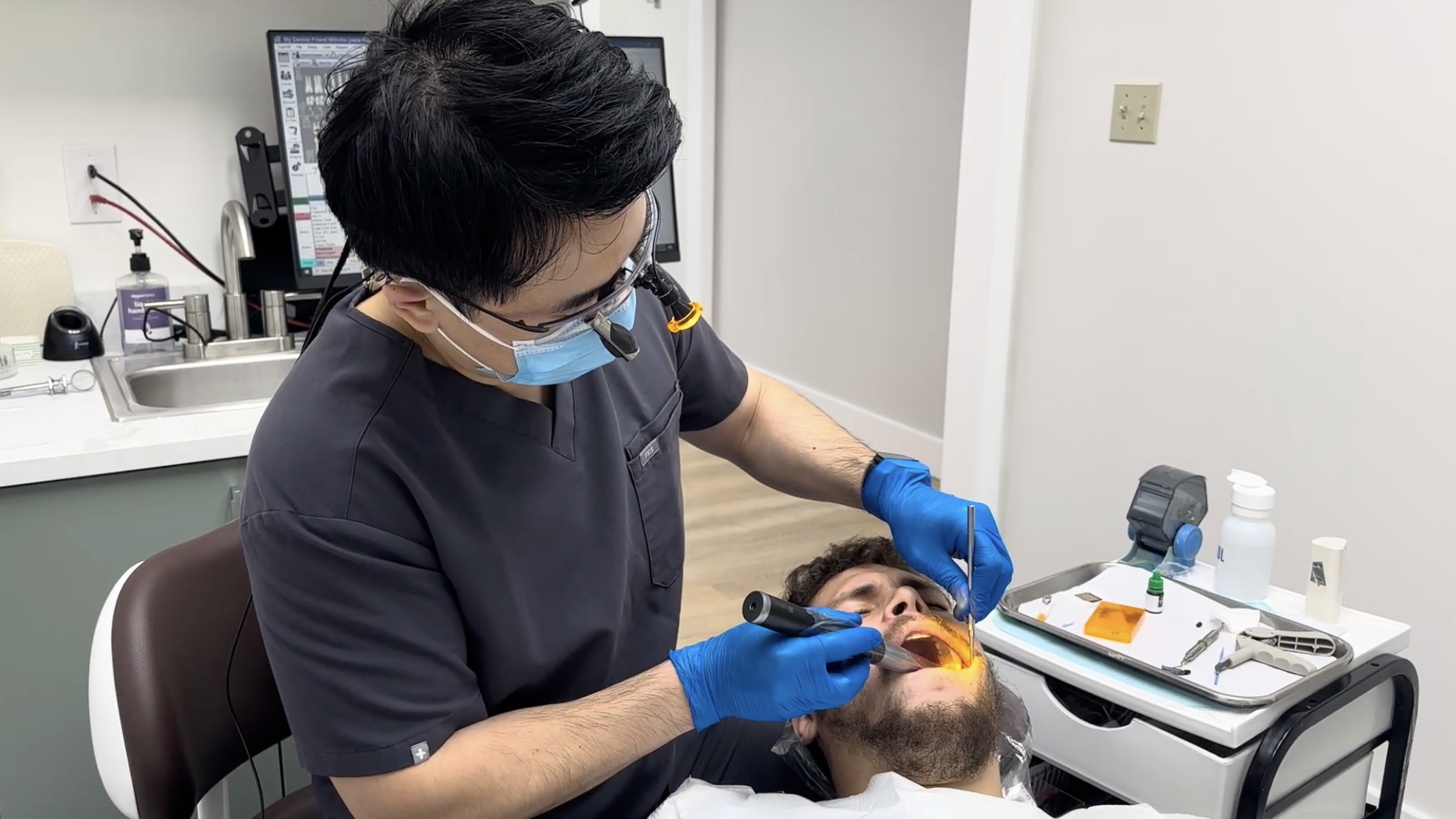
If a tooth has become decayed, chipped or cracked, a filling can be used to restore some of its strength. Fillings can be made from a range of different materials. The filling material can be chosen according to a customer’s requirements, such as being aesthetically identical to a natural tooth. My Dentist Friend offers fillings in a range of different types to remove damage and decay from an oral cavity and improve your overall dental health.
book onlineWhat Is the Procedure for Having a Filling Placed?
An initial consultation appointment allows the patient and our Dentists to discuss the treatment. The patient will decide what type of filling they want, then schedule a date for its placement. Placing a filling is a routine procedure and can be done in 20 to 60 minutes. During the procedure, the patient will be under local anesthesia to numb the tooth and the surrounding tissue. The dentist will remove the decayed areas of the tooth and thoroughly clean it to prevent bacteria from being stuck under the filling. The filling will then be placed in the filed area. There will be aftercare instructions to which the patient must adhere, as the surgery site will be sensitive. Note that the patient will still be under the influence of the local anesthesia.
What Are the Different Types of Fillings?
The most common type of filling is an amalgam filling, which is made up of a selection of different metals, making the filling cheaper but stronger. Amalgam fillings are more conspicuous compared to other fillings, as they are usually reflective silver color, which makes them good for teeth at the back of the mouth. They usually last 10 to 15 years, but they can last longer with the excellent upkeep of the patient’s oral health. Inlays & onlays are a special type of filling that can deal with more significant damage to the biting surface of a tooth. They are usually made of porcelain, and are practically undetectable from the rest of the tooth it is placed on. They can last up to 30 years.
Composite fillings are made from plastic resins that are also effective at blending in with the rest of the oral cavity. They can be matched to the color of the patient’s teeth. They can stain over time however, and usually last 5 to 7 years.
Avoiding Fillings
We are happy to accommodate any fillings that a patient may need, whether it be from an injury they received, or from neglect to their oral health. However, for the future, we can advise our patients on how to prevent the need for a filling again. Patients who play a contact sport should invest in a custom-fit mouthguard to protect their teeth. Our office can create a custom mouthguard that offers the best protection for a patient’s teeth. Brushing twice a day for two minutes will prevent plaque from accumulating and causing other cavities.
My Dentist Friend can fit your next filling and wants to make the process as effective as possible. Contact our office at 856-484-4114 to book your consultation appointment.
Inlays and Onlays

When the damage to a tooth is too significant for a filling, and a crown would get rid of too much of the healthy tooth’s enamel, inlays and onlays can be used as a restoration. Like large fillings, inlays and onlays are used when large parts of the biting surface of the tooth have to be removed due to damage in order to maintain the strength of the tooth. My Dentist Friend uses both inlays and onlays as an effective treatment to strengthen a patient’s oral cavity and allow our patients to retain as much of their natural tooth as possible.
book onlineWhat Is the Difference Between Inlays and Onlays?
The difference between inlays and onlays is determined by where the damage is located. Onlays are generally used when the damage is more significant and one or more of the tooth’s cusps have been affected. The cusps of a tooth are the rising points, which are numbered at four on molars. Inlays are used when the damage is less significant and does not affect the cusps. Inlays and onlays are both often made from porcelain or resin, which makes them indistinguishable from the rest of the tooth. This invisibility, combined with their strength, makes them more desirable when compared to the traditional filling. Our Dentists will advise our patients on the best restorative procedure for them and what their possible options are.
How Are Inlays And Onlays Placed?
The placing of an inlay or onlay happens over two appointments. At the first appointment, our Dentists will remove the decayed parts of the enamel and thoroughly clean the tooth to avoid the collection of bacteria. This process will take longer for an onlay, but the process takes roughly an hour. During the appointment, the Dentists will take measurements and send them to a dental lab. There, the dental lab will make a custom-fit inlay or onlay. A temporary inlay or onlay will be placed in the meantime. There will be aftercare instructions that need to be followed diligently to avoid any complications.
The second appointment will be scheduled for when the custom-fit inlay or onlay is ready. The temporary inlay or onlay will be removed, and the custom-fit one will be placed and secured. This should also take about an hour. Some sensitivity will be felt for several days afterwards. Our Dentists will provide aftercare instructions. Inlays and onlays do not require any special care and can be cleaned in the same way as a normal tooth. They can last over 25 years and are meant to be a permanent tooth restoration. With proper maintenance, the patient may not need to have them replaced.
My Dentist Friend offers inlays and onlays as a way to restore a tooth back to its original strength while taking away as little of the healthy enamel as possible. Every inlay or onlay is unique to each patient. Talk to one of our Dentists to see if an inlay or onlay could be used for your next restoration. Contact our office at 856-484-4114 to book your consultation appointment.